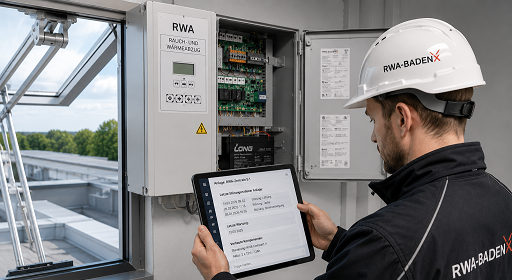
The digitalization of maintenance and service processes is becoming increasingly important, including for smoke and heat exhaust ventilation systems (SHEVs). Technical documentation, maintenance logs, circuit diagrams, manufacturer specifications, and system data are now generally available in digital format—though often scattered across various systems and data sources. Consequently, service technicians and planners frequently spend a significant amount of time searching for relevant information.
Against this backdrop, RWA-BADEN GmbH and KItelligence GmbH investigated the feasibility of an AI-powered knowledge assistant as part of a project funded by the state of Baden-Württemberg. The goal was to develop a solution that consolidates information from technical documentation and the RWA-Maintain maintenance management system, making it accessible via natural language.
In many companies within the security and building technology sectors, relevant information exists in various formats. Alongside manufacturer documentation and operating manuals, there are maintenance logs, fault reports, circuit diagrams, and technical drawings, as well as structured data from maintenance management systems.
The feasibility study shows that employees today often have to search through multiple systems or rely on the experiential knowledge of individual colleagues to find answers to technical questions. This can consume valuable time, particularly in the event of malfunctions or safety-critical incidents.
Typical questions arising in the course of daily work include, for example:
The information is there, but not centrally available.
A key foundation of the project is the "RWA-Maintain" maintenance management system. The platform is used to manage systems, components, maintenance data, events, and organizational information. This creates a structured database that can be linked to technical documentation and manufacturer records.
The following data sources were particularly taken into account in the study:
Consolidating this information creates a company-wide knowledge base that users can access via a chat interface.
Technically, the solution is based on a so-called Retrieval Augmented Generation Architecture (RAG). This is an approach in which a language model does not only rely on its trained knowledge, but rather specifically researches information from internal documents and databases.
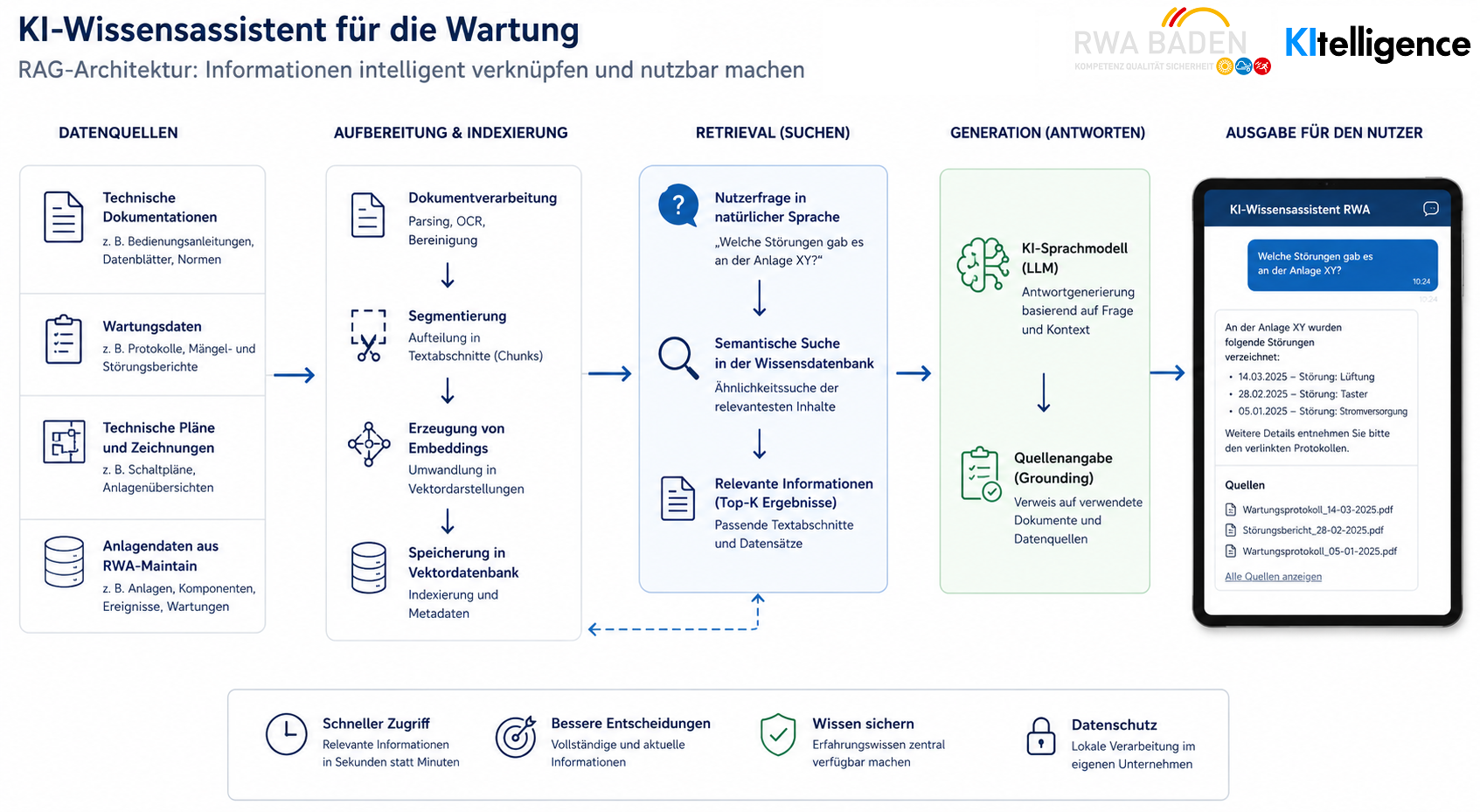
The process is comparatively simple:
The decisive advantage: The answers are based on information actually available within the company and can be traced back to specific documents or datasets.
For the feasibility study, a prototype was built and tested using practical scenarios. The test cases were based on typical requirements from planning, service, and maintenance.
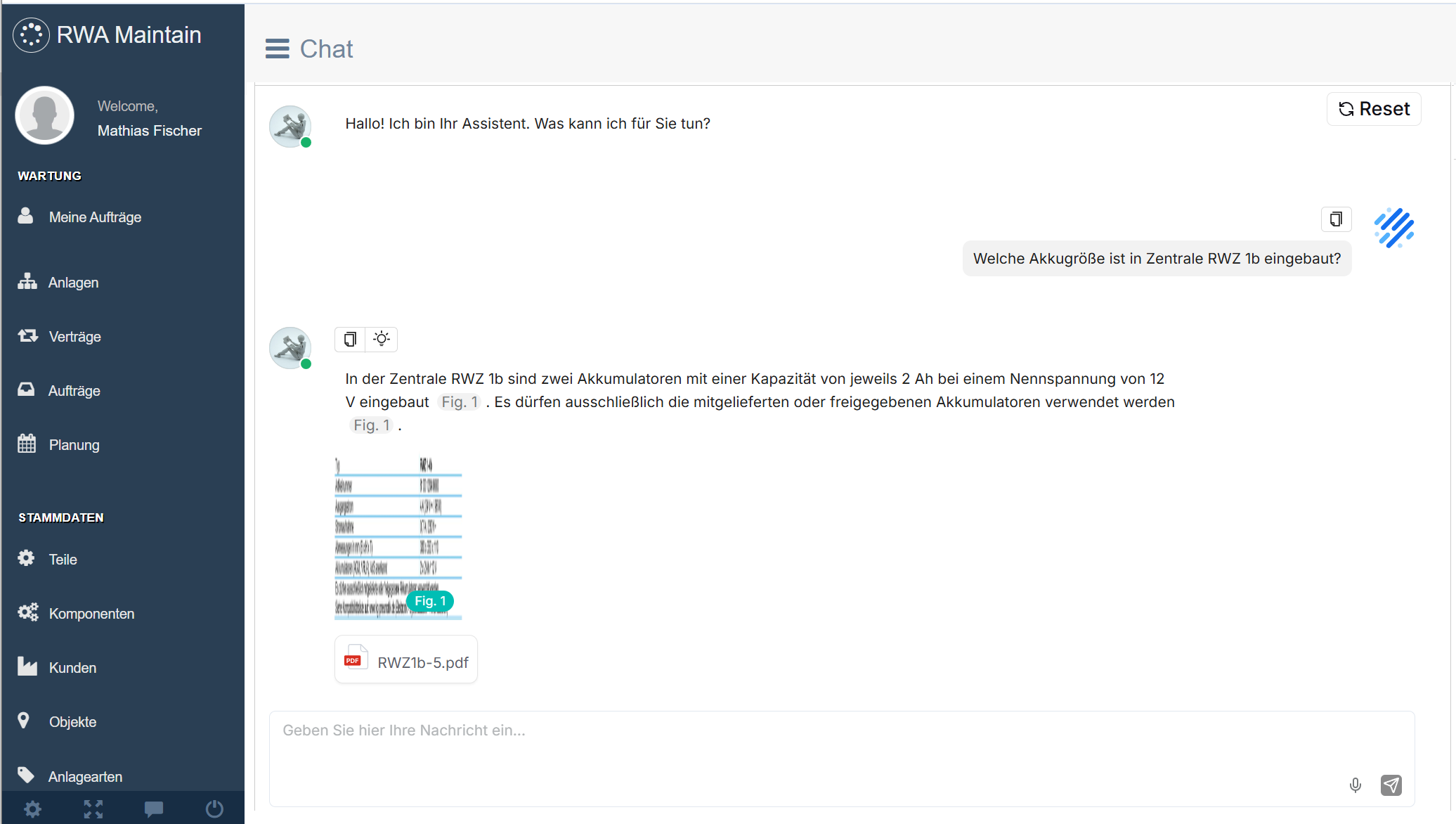
Among others, the following scenarios were examined:
The results show that high-quality search results were achieved, particularly with structured asset information and well-prepared documentation. At the same time, it became evident that the quality of the answers depends significantly on the quality and structure of the underlying data.
From a practical perspective, the technology opens up several interesting fields of application.
An important aspect of the study was the issue of data protection and data security. The architectural approaches examined rely on locally operated language models and vector databases. This allows sensitive corporate data to remain within the organization's own IT infrastructure.
This point is of great importance, particularly for companies in the security sector, as technical documentation and system data often contain confidential information.
The study's authors rate the technical feasibility positively overall. The developed proof of concept demonstrated that AI-based knowledge assistants can effectively support real-world use cases in planning, service, and maintenance.
The next step takes the form of a pilot project with selected users. The focus is on the further integration of RWA-Maintain, the optimization of data quality, and the establishment of a secure role and authorization concept.
The feasibility study by RWA-BADEN and KItelligence demonstrates that modern AI technologies have the potential to fundamentally transform information and knowledge processes within the service and maintenance sector. Technicians can access relevant knowledge more quickly, make better use of historical information, and handle technical issues more efficiently.
Even though further organizational and technical steps are required before they can be put into productive use, there are strong indications that AI-powered knowledge assistants could become an integral part of digital maintenance processes in safety and fire protection technology.

 DE
DE